For video engineers in theatre, live events & broadcast

Build the show before the kit arrives.

PatchHub is a desktop app for planning, patching and documenting a video system, and for driving it on the day. Build the rig once and the same system gives you the schematic, the patch sheet, the kit list, the crew’s read-only page — and, on supported kit, the live control.

£149 inc. VAT, one-off. Seven-day trial, no card. In beta with a small group of testers.

macOS & Windows  ·  works fully offline  ·  in beta — not released yet

Show Overview — SchematicLive
BMD URSA G20 in · 1 outCAM 1GFX laptop0 in · 1 outGFXZoom laptop1 in · 1 outZOOMVideohub 40x4040 in · 40 out1CAM 12GFX3ZOOMPGMMVRECATEM 4 M/E20 in · 6 out1CAM 1PGMRECHyperDeck HD4 in · 2 out1REC APanasonic laser2 in · 0 out1SCREENMultiView16 in1MVCAM 11CAM 1PGMMV1CAM 1PGM1MV1SCREENRECDeck B4 in · 2 out1REC B

Who it is for

Built for the person who gets handed the rig.

Freelance video engineers

Turn up with the patch already drawn and the labels already typed, instead of building it on a laptop in the truck.

Video departments

One way of documenting a rig, so the drawing from the last job is readable by whoever picks up the next one.

Theatre and venue teams

House ties, wall boxes and FOH runs stay documented between productions rather than living in one person’s head.

Production and AV companies

The same file goes to the designer, the crew chief and the hire desk, and they are all reading the same rig.

How it works

Plan it, draw it, then run it, all from one computer.

The rig you type in once is the rig you draw, the rig you print, and the rig you patch on the day. Change a label on the day and the drawing you handed out is already right.

01Plan

Build the show before the kit arrives

Lay the whole rig out on screen weeks before a single box is racked: routers, patchbays, switchers, converters, projectors, laptops. None of it has to be plugged in yet.

Pre-build Constellations

Set an ATEM up while it is still in the flight case: the auxes, the multiviewer, every label. When the switcher is racked and on the network, one press writes the lot to it.

Fit the cards, the I/O follows

A Barco Event Master or an Analog Way Aquilon arrives as an empty chassis and its page is a drawing of the real rear panel. Drop cards into the bays and the inputs and outputs appear as they would on the unit. Put a card in a slot that will not take it and the frame says no, exactly as it would in the rack. Save the build and drop it onto the next show.

Real models, not rectangles

Add a Barco PDS-4K or a Roland V-160HD and the right sockets are already on it, down to which inputs are HDMI and which are SDI. Every port list was typed in off the manufacturer’s own spec sheet, so what you draw is what you will find behind the rack.

02Draw

A drawing that knows what the kit actually is

Drag a device onto the canvas and it brings its real ports with it, so you cannot draw a cable into an input the box has not got. When you are ready to print, auto-arrange lays the whole thing out to fit the paper.

Patch Sync

Name a camera once and the name travels with its signal through every patchbay, router and converter it passes through. Rename it at the source and the whole chain follows, so no panel is left saying CAM 3 a week after CAM 3 became the roving.

Draw it the way you think about it

Ring the FOH rack as a zone, name it, and group it so the whole lot drags as one. Cables find their way round boxes instead of disappearing under them, and collapsing a device to save space keeps every cable attached to it.

Hand it over

Print it as a PDF, hand production an Excel patch sheet, pull a kit list with quantities for the hire company, or send the crew a read-only link that opens on a phone.

03Run

Then drive it for real

The drawing you made weeks ago is the thing you now drive the show from. Routers, switchers and projectors answer in one window rather than one app per box, over the same protocols their own control software uses.

Crosspoints, labels, locks

Change them live across the whole rig, then set the patch lock so nobody moves a route mid-show.

Every projector, one button

Panasonic, Epson, Christie and Barco all speak PJLink, so PatchHub drives the lot: close every shutter for the reset, power the room down at the end of the day, or take one unit on its own. It reads them too — lamp hours, the input each one is on, and a temperature or filter warning while it is still a warning.

Show Day

One screen for the day itself: the patching checklist, the read-only link for the crew, the projectors, and a shortcut to every piece of kit the app can actually talk to.

Record and deliver

One master REC rolls every HyperDeck and AJA deck at once. You get a take sheet, markers on a hotkey, and an edit-ready project built from any take.

Patch Sync

Name it once, at the camera.

Type a name on the source and it travels with the signal through every panel, router and converter it passes. Rename it and the whole chain follows, so nothing downstream is left insisting a feed is something it stopped being three days ago.

CAM 3 Stage rack 1 House tie 12 FOH patch Videohub in 7 ATEM in 4

Every one of those panels now reads CAM 3, including the printed sheet and the crew’s page.

The application

What it actually looks like.

Screens from the app, not mock-ups. These are being captured from a real show file and will land here before launch.

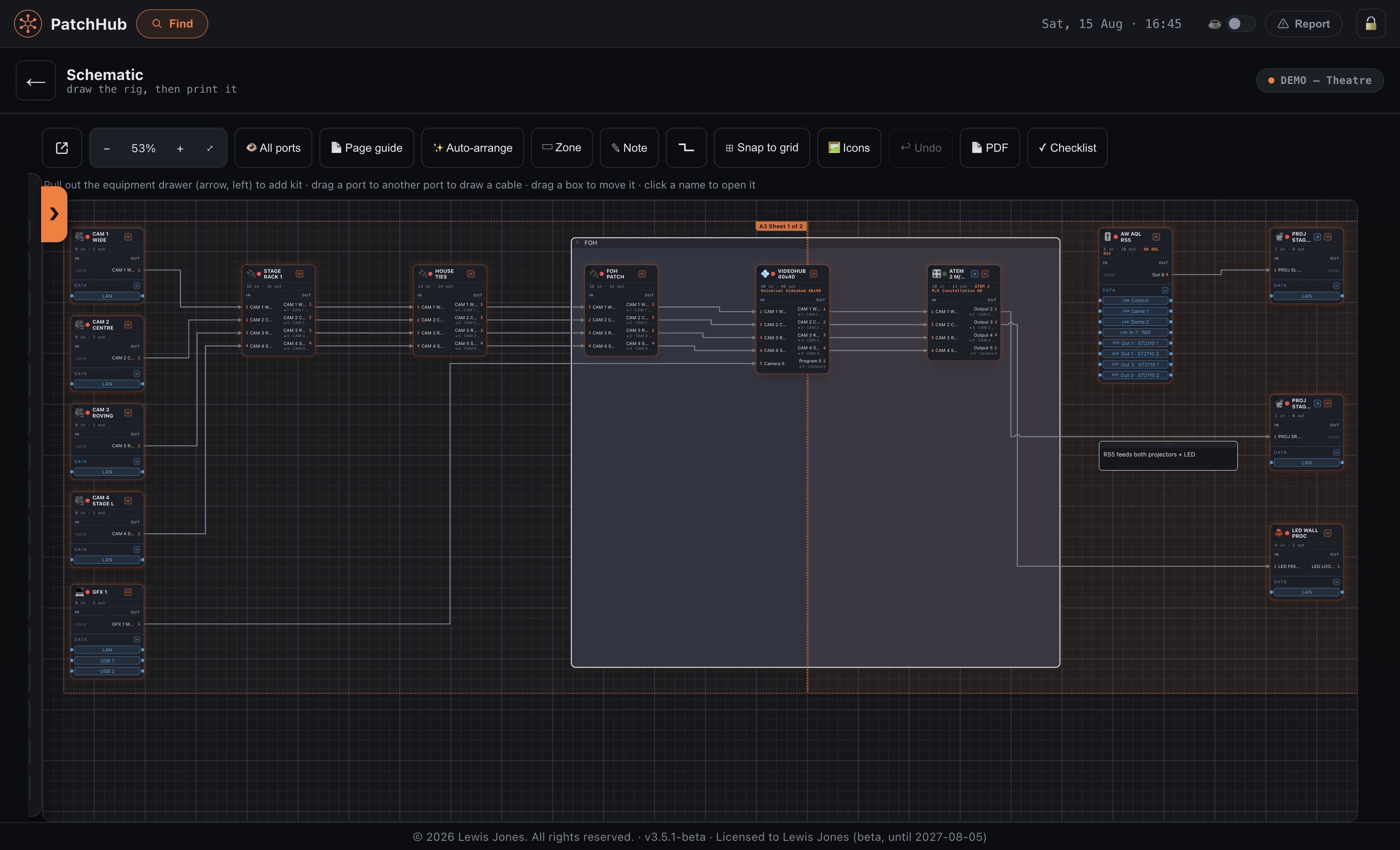
A theatre rig drawn in PatchHub: four cameras through a stage rack, house ties and FOH patch into a Videohub 40x40, then an ATEM 2 M/E, out to an Aquilon RS5, two projectors and an LED processor
A theatre rig in the schematic: cameras through the stage rack, house ties and FOH patch into the Videohub, the ATEM, then out to the RS5, projectors and LED. The orange guide is the A3 sheet it will print on.
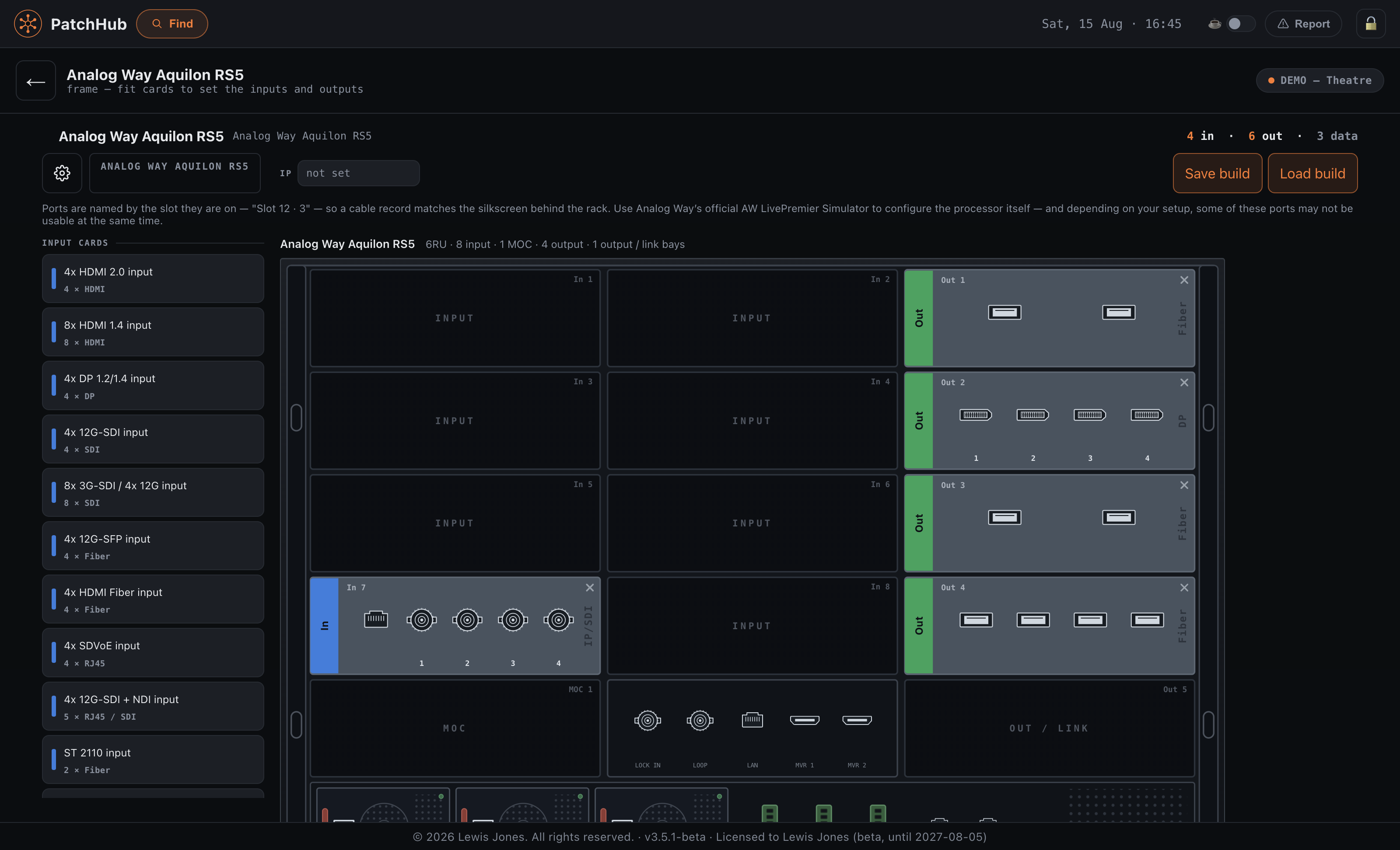
The Aquilon RS5 frame page with cards fitted into its bays: an IP/SDI input card and four output cards, each drawn with its real connectors
The RS5 as a drawing of its own rear panel. Fit the cards and the I/O follows; ports are named by the slot silkscreened on the metal.
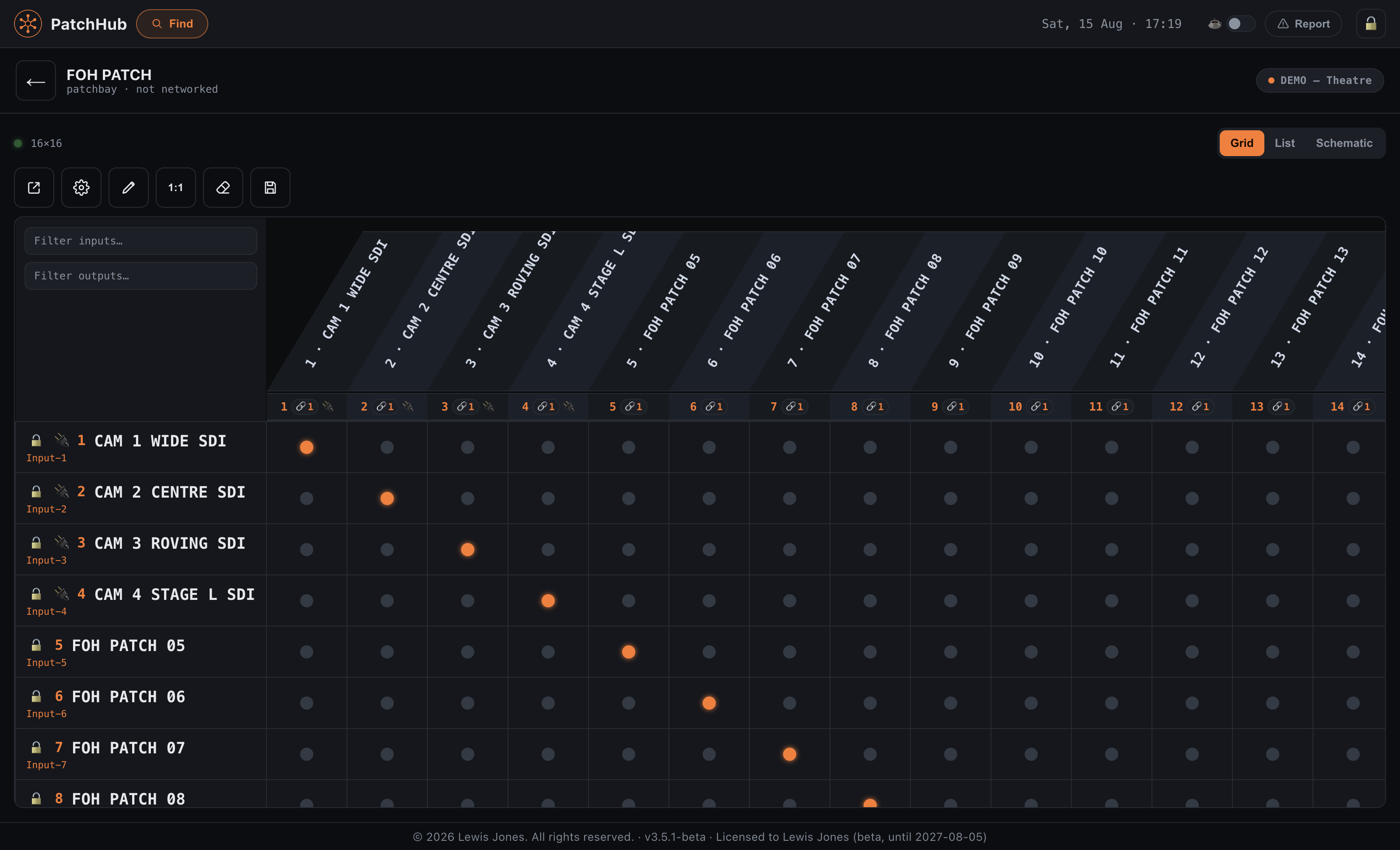
The FOH patch crosspoint grid, with camera names carried down the chain by Patch Sync
The FOH patch. The camera names were typed once, three panels upstream — Patch Sync carried them here.
The Show Day screen: two projectors identified over PJLink with lamp hours and shutter controls, and the live controllable kit below
Show Day. Both projectors identified themselves over PJLink — model, serial, lamp hours — with shutter and power for each or the whole room at once.
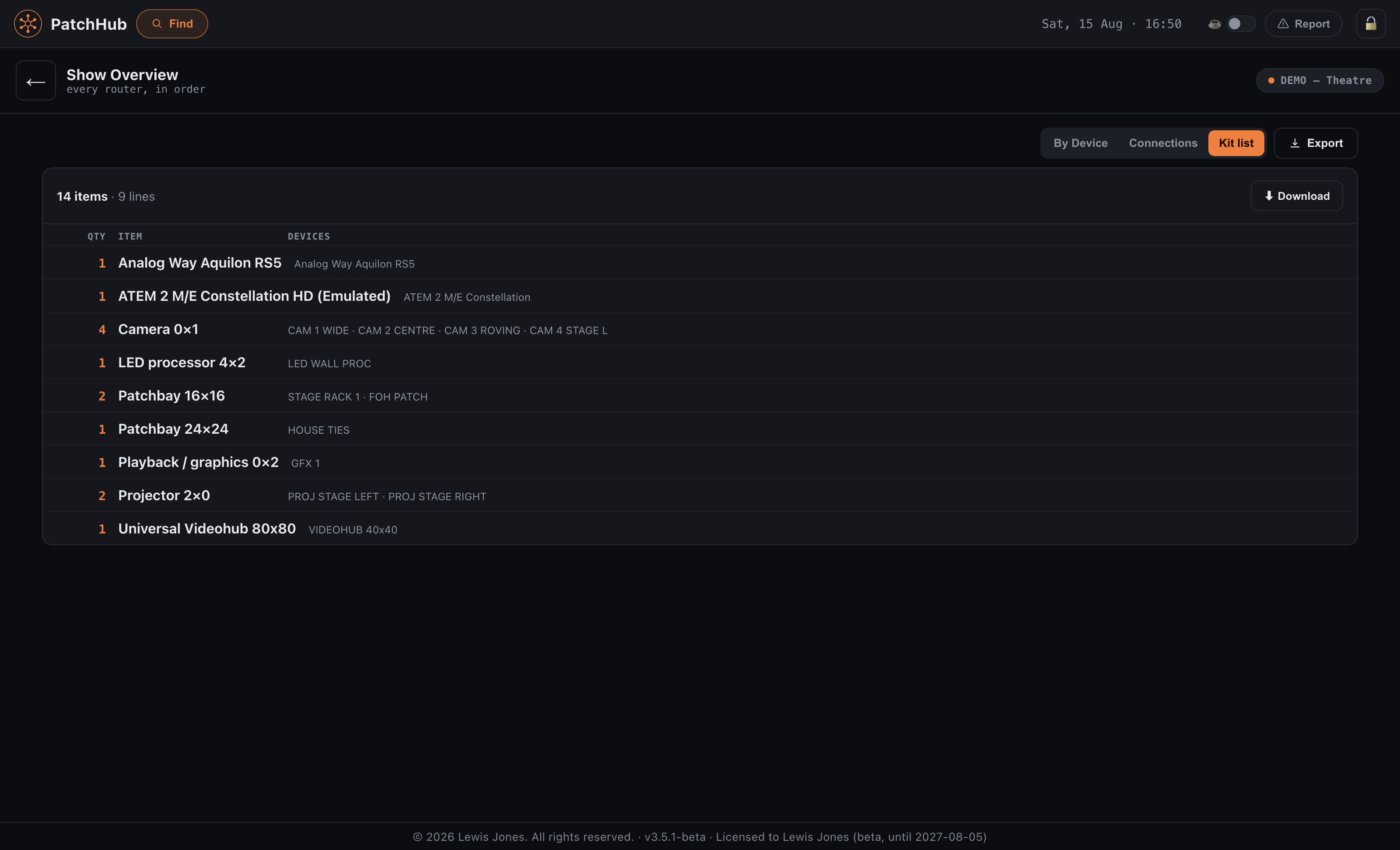
The kit list, generated from the rig: quantities against each model, with the device names that make up each line
The kit list writes itself — the rig already knows what is in it. Quantities per model, and which devices make up each line.
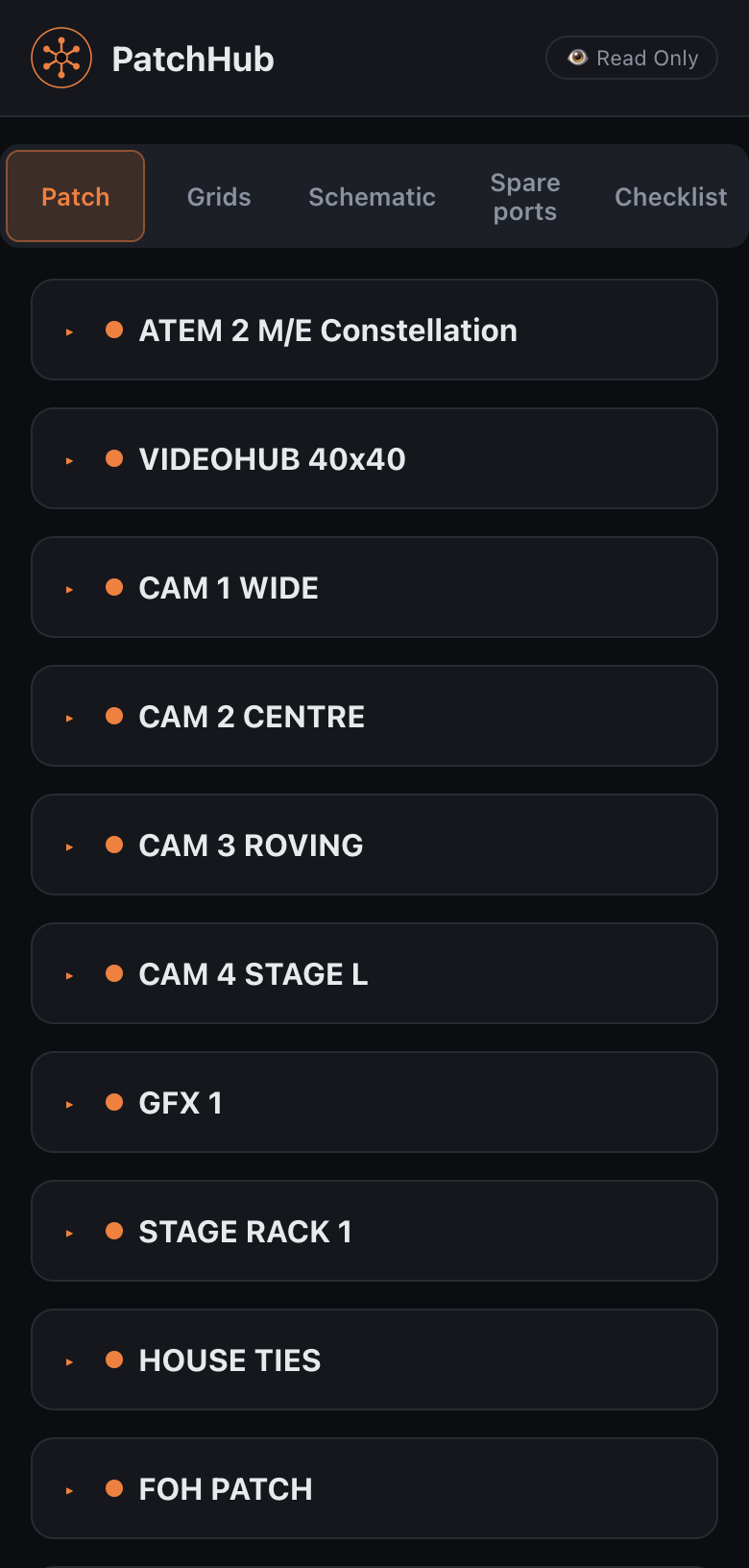
Public View on a phone: the whole rig listed read-only, with patch grids, schematic, spare ports and the checklist
Public View on a phone. The crew does not need PatchHub installed — a read-only page with the patch, the drawing and the checklist.

Supported kit

Real devices, with the I/O the manufacturer actually shipped.

PatchHub patches Blackmagic Videohub and ATEM for real, over their own protocols, and drives any PJLink projector. Everything else in the rig it draws and documents, down to a passive patch panel with no network port at all.

Drawing & cable tracking

Useful long before anything is plugged in.

You do not need a Videohub, an ATEM, or a single controllable box. Used as nothing but a drawing board, PatchHub keeps the rig, every cable run and the paperwork in one file, and prints a sheet a crew can follow at four in the morning. Same job whether the racks are in an OB truck, a theatre’s dimmer room or the back of a conference hall.

Schematics

Draw the rig, then print it

Drag kit onto the canvas and draw cables port to port. Lines are kept apart so each one can be traced by eye, and the drawing is laid out to fill the paper rather than sitting in a corner of it. Add zones, notes and labels where the drawing needs explaining.

Patch panels

Follow a signal through the panels

Record what lands on every panel port, under the ID engraved on the metalwork rather than a number the app invented. In a theatre that means the house tie lines, the wall boxes and the FOH run stay documented between productions instead of living in one person's head.

OB trucks

Know where every cable went

Track a run from the camera position, through the tie lines and the OB truck's panels, to the port it lands on inside. Print it for the tape, or share a read-only page the crew can open on a phone from the compound.

Pricing

PatchHub. Bought once, not rented.

PatchHub is the product — plan the rig, draw it, then drive it, recording included. TakeHub is a separate, smaller app for crews who only want the decks, and it is still in development; you do not need it to use PatchHub. Neither is a subscription, and neither depends on a licence server that could go down mid-show.

Not released yet. PatchHub is still in beta with a small group of testers. The prices below are what it will cost when it goes on sale, and the trial is the complete app rather than a cut-down one. Both the download and the checkout will appear here the day they are ready.

Trial
Free · 7 days

Either app, with a watermark on exports.

  • The complete app, nothing held back
  • Real hardware or the built-in emulators
  • No card, no account
Coming soon
PatchHub
£149 inc. VAT

One-off, not a subscription. One active machine at a time — move your licence when you change computer. Price when buying opens.

  • Plan, draw and drive the whole rig
  • Videohub and ATEM, live
  • Schematic, kit list and Public View
  • Recording included

Kitting out a fleet? £99 a machine from five, £89 from seven, priced automatically at checkout.

Coming soon
TakeHub · separate app
£39 inc. VAT

A separate app, still in development. PatchHub already includes recording — TakeHub is for crews who want only the decks.

  • Master REC across every deck
  • Take sheet, markers, pre-flight check
  • Edit-ready projects from any take
Coming soon

Thirty days, no questions asked. If it is not right for you, email us within thirty days of buying and we refund you in full — no reason required. One active machine at a time, and the app checks its key with no internet connection at all — which is the point, in a rack room or a compound. Move your licence when you change computer, or when a drive dies, by emailing us. Prices include VAT: what you see is what you pay, wherever you are, with the tax itemised on your receipt.

Questions

The things worth knowing first.

Does PatchHub work offline?

Yes. It runs entirely on your machine — no cloud, no account, and it checks its own licence key without an internet connection. The only things that need a network are the ones that obviously do: talking to your hardware, and sharing the crew’s read-only page.

Is it a subscription?

No. One payment, and the version you buy is yours.

Can I move my licence to another computer?

Yes. One active machine at a time, and it moves with you — email us and we reissue it. Change of laptop, or a dead drive, is not a second purchase.

Does it run on macOS and Windows?

macOS is the version in daily use through the beta. There is a Windows build, and it is newer and less tested — if you are on Windows, use the trial before you buy.

Can I build the rig before I have the hardware?

That is what it is for. Devices, cards, ports and cabling are all documented without anything plugged in, and the built-in emulators let you drive a Videohub or an ATEM that is still in a flight case. When the real kit arrives you point the same file at it.

Which hardware can PatchHub control?

Live control today: Blackmagic Videohub routers and ATEM switchers over their own protocols, PJLink projectors (which covers Panasonic, Epson, Christie, Sony, Barco and others), and HyperDeck and AJA recorders. Anything else — Barco and Analog Way processors, patchbays, converters, cameras — is documented and drawn rather than driven. The AJA path is written to AJA’s published API but has not yet been proven against a real deck.

Does PatchHub count my cables?

No, and it is worth being precise about this. PatchHub tracks individual cable runs — every one you draw is a real record, port to port, and it appears in the drawing, the reports and the checklist. It does not add them up into an order for the hire company. The kit list gives you equipment quantities; the cable schedule gives you the runs.

What if I buy it and it is not right for me?

Thirty days, no questions asked. Email us within thirty days of buying and we refund you in full, without asking you to justify it. Your key stops working when the refund goes through, and that is the only string attached — though with a seven-day trial of the complete app, we would rather you never needed it.

What happens after the seven days?

The trial is the complete app, not a cut-down one. When it ends, exports carry a watermark until a key goes in — your show files are yours either way, and nothing you built is locked up.

When can I actually buy it?

Not yet. PatchHub is in beta with a small group of testers, and the download and checkout will appear on this page the day they are ready rather than a day before.

Ready to build the rig before the kit arrives?

Seven days, the complete app, no card and no account. Exports carry a watermark until a key goes in.